 Oahu Volcano Tours
Best Time to Visit Oahu Volcanoes
The best time to visit Oahu volcanoes depends first on the hour and only then on the month. Oahu has no active volcano, so the lava you might see is on the Big Island, a flight of about one hour each way. This page sorts the timing by place. Sunrise works at Diamond Head, sunset works on the Koko Crater stairs, and mid-morning is when the Hawaii Volcanoes National Park gates on the Big Island are calmest. It also explains the wet Hilo side against the dry Kona side, and how the two-year eruption of Kilauea shapes what any date can promise. Start with the honest summary, then pick your hour, and it sits alongside the Oahu volcano tour comparison.
Quick answer Timing at a glance
The best time to visit Oahu volcanoes is 5:00 AM for a Diamond Head sunrise, sunset for the 1,048 steps of Koko Crater, and mid-morning for the caldera overlooks on a Big Island day trip, since Hawaii Volcanoes National Park is open 24 hours a day and you want daylight inside it. Oahu's own craters are extinct tuff cones, so timing there is about crowds and heat, not lava. The active lava at Kilauea erupts in episodes lasting under 12 hours, separated by pauses of two or more weeks, so no date guarantees a show.
Key takeaways
- Book the Diamond Head sunrise shuttle and you are back at your hotel by about 8:00 AM.
- For sunset on a crater rim, the Koko Crater sunset hike puts you at the summit bunkers as the light goes.
- To see the active volcano, the Big Island day tour with hotel pickup runs 12 hours 30 minutes door to door.
- Not sure what Oahu can and cannot offer? Read which Hawaii volcanoes are active.
Time of Day First
The hour you choose changes the experience more than the month does. Here is what each window is worth.
Sunrise at Diamond Head
Diamond Head opens at 6:00 a.m. daily and the trail takes 60 to 90 minutes round trip. A sunrise start means cool air on a climb with no shade, and the monument covers over 475 acres, so the summit area is the only crowded part. Non-residents need a reservation booked up to 30 days ahead, and you must arrive within the first 30 minutes of your slot or you can be turned away with no refund. The last reservation slot is 4:00 p.m. and you must be on the trail by 4:30 p.m. The cheapest way in is $5 per person on foot or $10 per vehicle. If you want the shuttle version, Blue Wave's sunrise tour collects you at 5:00 to 5:10 AM and returns you to Waikiki by about 8:00 AM.
One honest caveat for sunrise chasers: the site reviews score its value for money at 3.9 out of 5, because the same entry costs $5 if you book the state reservation yourself and drive.
Sunset at Koko Crater
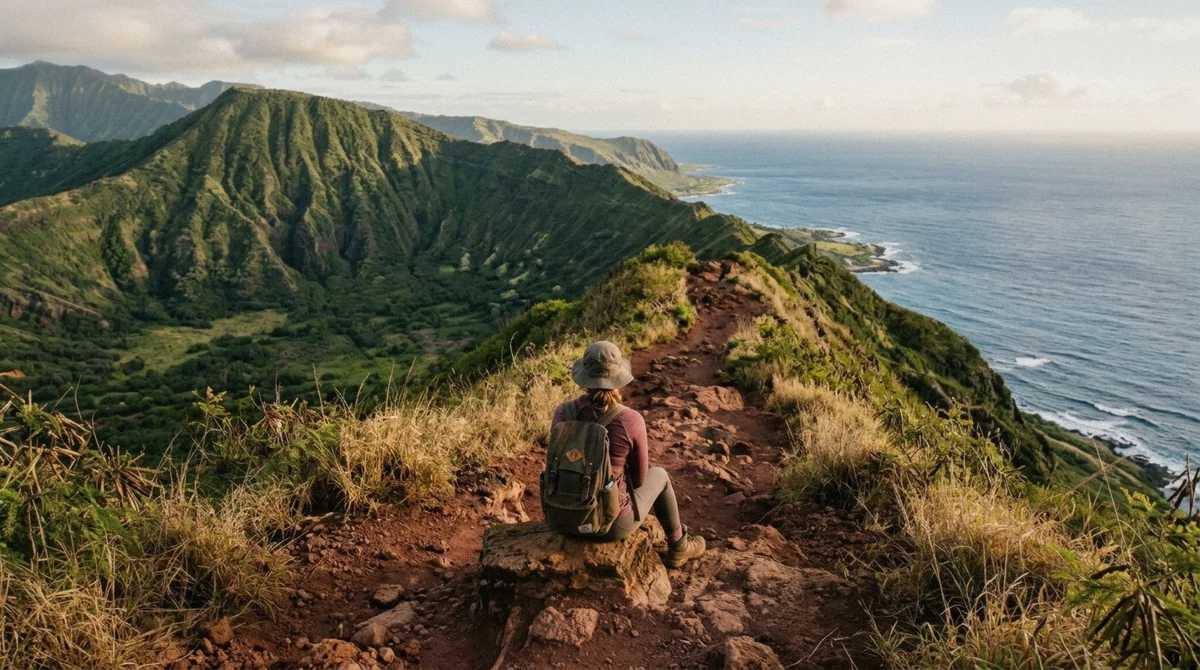
Koko Head District Park is free and never closes, which makes sunset the natural hour for the 1,048 steps up a Second World War tramway. Climbing in full midday heat is the worst version of this hike, because the sleepers face the sun and there is no water on the way. At the top sit WWII pillboxes and bunkers, with views to Hanauma Bay, Diamond Head and, on clear days, Molokai. The guided option, Oahu Hiking's sunset departure, runs 3 hours 30 minutes, costs $129, takes pickup from any Waikiki address and sets a minimum age of 5. Above the trailhead the climb is self-guided, so time your descent before full dark.
If you prefer a gentler volcanic walk in the same afternoon window, the rainforest hike on the Koolau slopes is a 3 hours 30 minutes outing with about 3 hours on the trail and 600 feet of climbing, and it excludes children under 8.
Mid-morning on the Big Island caldera
Hawaii Volcanoes National Park on the Big Island is open 24 hours a day, 7 days a week, including holidays, so timing is about daylight and flight schedules rather than gates. Day trips from Oahu land at Hilo or Kona after a flight of about one hour, and the door-to-door day runs 12 to 16 hours depending on the listing. That puts most groups at the Kilauea Visitor Center, the steam vents and the Nahuku lava tube in the middle of the day, which is exactly when the caldera is easiest to read. It is also when the summit's two-year construction project causes closures and delays, so build slack into any stop.
The Polynesian Adventure helicopter day claims the longest stated park time of any listing, 3 hours 50 minutes inside the park, which matters when your window on the ground is the whole point of the trip.
Hour by hour compared
The table lines up the three working time windows for volcanic sightseeing from Oahu. Figures come from the Hawaii state parks reservation system, the operator listings and the national park hours page, all for September 2026.
| Window | Where | Cost basis | What you get | Watch out for |
|---|---|---|---|---|
| Sunrise, from 6:00 a.m. park open | Diamond Head summit | $5 per person or $10 per vehicle | Cool climb, 60 to 90 minutes, summit light | Reservation slot rule, turned away with no refund if late |
| Mid-morning | Kilauea caldera, Big Island | Park entry $30 per vehicle, valid 7 days | Steam vents, visitor center, lava tube in full light | Construction delays, Hilina Pali Road vehicle closures Monday to Thursday |
| Sunset | Koko Crater summit bunkers | No entry fee, guided tour $129 | 1,048 steps, views to Hanauma Bay and Molokai | Steep descent in fading light, no water on the route |
Sources: Hawaii Volcanoes National Park, Hawaii State Parks and the USGS Hawaiian Volcano Observatory.
Wet Hilo Side or Dry Kona Side
The year matters on the Big Island because the two arrival airports sit on opposite sides of a wet-dry split.
Hilo, the wet side
Hilo sits on the east side, about 215 miles from Honolulu, and it is the arrival airport for most volcano day trips. It is the close airport to Hawaii Volcanoes National Park, which keeps the driving short and the day tighter. Hilo's side of the island is the wet one, home to the rainforest around the park and waterfalls such as Rainbow Falls, which several tours loop in.
Expect green ground, cloud that builds through the day and trail surfaces that stay damp after rain. Bring a shell even on a day that starts clear.
Kona, the dry side
Kona sits on the west side and gets the drier, sunnier weather pattern, which is why the Kona coffee belt grows where it does. The trade is driving time. Two listings fly to Kona and cross the island to reach the park. Aloha Sunshine's small-group day crosses through the coffee belt and Punaluu black sand beach and caps the group at 14, while Hawaii Island Experiences states 2 hours inside the park after crossing from Kona and carries the strongest review record of any day trip, 4.75 from 272 ratings, with a Punaluu bake shop stop instead of included lunch.
The pack gives no monthly rainfall figures for either side, and this page will not invent them. What is fixed is the routing: Hilo means a short ride to the park, Kona means a long scenic one.
The Kahuku unit as a dry-side alternative
The national park also runs the Kahuku Unit, 70.5 miles south of Hilo, open Thursday to Sunday, 8 a.m. to 4 p.m. It sits in the drier southwest of the island, so a Kona-routed day with a free day to spare can pair with it. Note the other standing closures before you plan around it: the Sulphur Banks Bridge is closed until further notice though the boardwalk stays open from the west side near Steam Vents, the Kipukapuaulu Trail is closed for hazardous trees, and Hilina Pali Road beyond the Maunaiki Trailhead is closed to vehicles 6 a.m. to 4:30 p.m.
Monday to Thursday until 19 November 2026.
When the Lava Actually Flows
If lava is the reason for your timing, the honest numbers come from the eruption's own rhythm, not from a calendar.
What no date can promise
Kilauea has been erupting episodically from vents in Halemaumau crater since 23 December 2024. As of the USGS Hawaiian Volcano Observatory update of 17 September 2026 the volcano stands at alert level WATCH with an aviation colour of ORANGE, and there had been 54 fountaining episodes between the start and that date. A fountaining episode generally lasts less than 12 hours, and episodes are separated by pauses of two or more weeks. The most recent episode, number 54, ran about 9 hours on 25 August 2026, with the north vent fountain reaching roughly 500 feet (150 m) and the plume about 17,000 feet (5,200 m).
On the day checked there was no active lava on the ground, though the north, south and west vents glowed. Between episodes the summit releases 1,000 to 5,000 tonnes of sulphur dioxide a day. For what those episodes look like close up, see what an erupting episode actually looks like.
Why timing still helps
You cannot schedule an episode, but you can position yourself. A glow is visible after dark, so a tour with early morning at the caldera on the day after an episode still shows steaming vents and fresh ground. The eruption sits inside a closed area of the park, and the Halemaumau crater rim has been closed to the public since late 2007, so nobody, on any tour, at any hour, walks to the vent.
A tephra caution is standing at the summit, where ash, rock and glassy strands can irritate skin, eyes and airways. Any operator promising lava on a fixed date is selling something the volcano has not agreed to, and what erupting means in Hawaii explains the gap between the words.
A morning against an evening at the summit
This box matches your available time of day to the realistic volcanic payoff, using the standing conditions above.
| If your free window is | On Oahu | On the Big Island | Lava odds |
|---|---|---|---|
| Dawn | Diamond Head sunrise from a 5:00 AM pickup | Flight arrives Hilo or Kona late morning | None after dark, glow window missed |
| Midday | Heat on the Koko stairs, avoid it | Caldera overlooks, visitor center, lava tube | Vent glow possible in daylight only as haze |
| Dusk and after | Koko Crater sunset bunkers | Park open 24 hours, dark overlooks | Best odds of a visible glow, never a promise |
Hours, Reservations and Closed Days
Timing fails on closed days. These are the fixed gates that override every other plan.
The two closed days that catch visitors
Diamond Head closes on Christmas Day and New Year's Day, and Hanauma Bay closes on Mondays, Tuesdays, Christmas Day and New Year's Day. Everything else runs through the holidays. The national park is open 24 hours a day, 7 days a week, including holidays, and Koko Head District Park is free with no stated closure.
Diamond Head is secured by the Department of Defense after 6 p.m., so there is no evening version of that crater.
Hanauma Bay's clock
Hanauma Bay, the flooded tuff cone, allows entry only between 6:45 a.m. and 1:30 p.m., clears the beach at 3:30 p.m. and has everyone out by 4 p.m. Non-residents reserve through the PROS system, which opens two days ahead at 7 a.m. Hawaii time, or book a Roberts Hawaii package with transport up to a month ahead.
Every visitor watches the education video on every visit, and online payments carry a 2.35% service fee with parking paid on site in cash. Hawaii residents with ID, US military with military ID, and children 12 and under enter free. The preserve drew nearly 845,000 visitors in 2019, almost 3,000 a day, and today takes roughly half that.
The full entry rules sit on the Hanauma Bay crater page.
The reservation windows that set your booking day
Two clocks govern when you can lock a time, so plan them together.
| Place | How far ahead | Entry fee | Closed days |
|---|---|---|---|
| Diamond Head | Up to 30 days ahead, arrive in first 30 minutes of slot | $5 per person, $10 per vehicle, free for Hawaii residents with state ID | Christmas Day, New Year's Day |
| Hanauma Bay | PROS opens 2 days ahead at 7 a.m., or Roberts package up to a month ahead | Fees with 2.35% online service fee, free for residents, military and children 12 and under | Mondays, Tuesdays, Christmas Day, New Year's Day |
| Hawaii Volcanoes National Park | No reservation stated, open 24 hours | $30 private vehicle valid 7 days, $25 motorcycle, $15 per person walk-in, under 16 free | None stated |
What Your Timing Costs
The hour you pick decides if you pay a tour premium or walk in for the state fee. The figures below are the listed prices for every tour on this site, with the state and park fees beside them, all from the operator listings and official fee pages.
The full price list
Any passage with five or more prices becomes a table, so here is the whole set in one place. The Big Island days cluster around $576 to $810, the Oahu walks run $64 to $129, and the state fees are a fraction of either.
| Option | Price | Duration | Timing angle |
|---|---|---|---|
| Diamond Head sunrise shuttle | $64 | 3 hours | 5:00 AM pickup, hotel by about 8:00 AM |
| Volcanic rainforest hike | $90 | 3h 30m | Daytime, about 3 hours on the trail |
| Koko Crater sunset hike | $129 | 3h 30m | Sunset at the summit bunkers |
| Big Island day, hotel pickup | $585 | 12h 30m | Full day from a Waikiki door |
| Big Island day, no helicopter | $576 | 16 hours | Longest day, 4am airport arrival |
| Big Island day with helicopter | $810 | 15h 30m | 3 hours 50 minutes in the park |
| Small group via Kona | $590 | 12 hours | Dry-side crossing, capped at 14 |
| Kona crossing, 272 reviews | $589.99 | 12 hours | 2 hours stated in the park |
| Dynamic Tour day | $680 | 1 day | Flight time learned after payment |
| Diamond Head self-guided entry | $5 per person | 60 to 90 minutes | Any reservation slot from 6:00 a.m. |
| National park entry, per vehicle | $30, valid 7 days | Open 24 hours | Cheapest caldera access |
What is cheaper without a tour
The honest math. Walking into Diamond Head costs $5 per person against $64 for the shuttle, a $59 saving for the price of your own 5:00 AM alarm and state reservation. Koko Head is free at any hour, so the $129 buys only pickup and a guide to the trailhead.
The national park charges $30 per vehicle or $15 per person on foot, valid 7 days, and children under 16 are free, against day trips from $576 to $810. What the tours buy is the flight, which runs about one hour each way over about 215 miles, plus ground transport and a compressed plan. If you want the full breakdown of every line item, the cost of an Oahu volcano tour page does the sums, and the budget options page lists the free ways onto volcanic ground.
Pick Your Window
Match your circumstances to a time slot rather than a calendar month.
If You want the classic crater photo with nobody's head in it
Take the Diamond Head sunrise shuttle or book the 6:00 a.m. state slot yourself for $5 per person, because the first hour is the quietest the monument ever gets.
If You are free only in the afternoon and evening
Climb Koko Crater toward sunset, guided or free on your own, and skip midday on those stairs entirely. The Koko Crater sunset hike handles the Waikiki pickup.
If You have one long day and want the active volcano
Accept the 12 to 16 hour door-to-door reality and choose by park time. The hotel pickup day tour removes the 4am airport run, while the helicopter version buys 3 hours 50 minutes on the ground.
If You hate rain and long drives
Route through Kona on the dry side, as the small-group Kona day does, and give up the short Hilo transfer in exchange for the coffee belt and Punaluu.
If You are chasing a lava fountain
Stop timing your trip and start timing your booking to the eruption news. Episodes last under 12 hours with pauses of two or more weeks, so read what an erupting episode looks like before you pay.
If You are travelling around the holidays
Note that Diamond Head shuts on Christmas Day and New Year's Day and Hanauma Bay adds Mondays and Tuesdays, while the national park never closes.
Timing Questions
What is the best time of day to hike Diamond Head?
The first hours after the 6:00 a.m. opening, when the climb of 60 to 90 minutes is cool and the reservation slots are quiet. The sunrise shuttle option is covered on the Diamond Head trail page.
Is sunset a good time for Koko Crater?
Yes, and it is arguably the best time, because the 1,048 steps face the sun and the park is free with no stated closing. The guided sunset version is the Koko Crater sunset hike.
What time do the Big Island volcano day trips start from Oahu?
Very early. Door-to-door days run 12 to 16 hours and the no-hotel-pickup listings mean clearing Honolulu airport yourself, with one listing describing a 4am arrival. The comparison is laid out in how to get to the park from Oahu.
Which side of the Big Island has better weather for a volcano day?
Kona on the west is the dry side and Hilo on the east is the wet side, so Kona routing trades a longer drive for sunnier ground. The wet-dry split is explained in the seasonal guide.
Is there a month when lava is guaranteed visible?
No. Fountaining episodes last under 12 hours with pauses of two or more weeks between them, 54 of them in under two years of eruption, so no month carries a guarantee. The eruption's rhythm is unpacked in what erupting means in Hawaii.
When is Hanauma Bay open to visitors?
Wednesday to Sunday only, with entry allowed 6:45 a.m. to 1:30 p.m., the beach cleared at 3:30 p.m. and everyone out by 4 p.m. The full rules sit on the Hanauma Bay crater page.
How far ahead should I book for the timing I want?
Diamond Head reservations open up to 30 days ahead, Hanauma Bay's PROS window opens two days ahead at 7 a.m. Hawaii time, and day trip listings split between free cancellation at 24 hours and non-refundable bookings. The booking strategy is on the advance and last minute page.